
A Major Discovery in Our Own Backyard
For years, the outer edges of our solar system have remained a mystery, populated by icy debris and distant, frozen worlds. Now, the Vera C. Rubin Observatory has pulled back the curtain on one of these hidden giants. Astronomers have officially announced the discovery of 2026 ED138, a massive trans-Neptunian object (TNO) located well beyond the orbit of Pluto. This candidate, identified by its significant brightness and size, is currently being evaluated to see if it qualifies as the solar system’s sixth recognized dwarf planet.
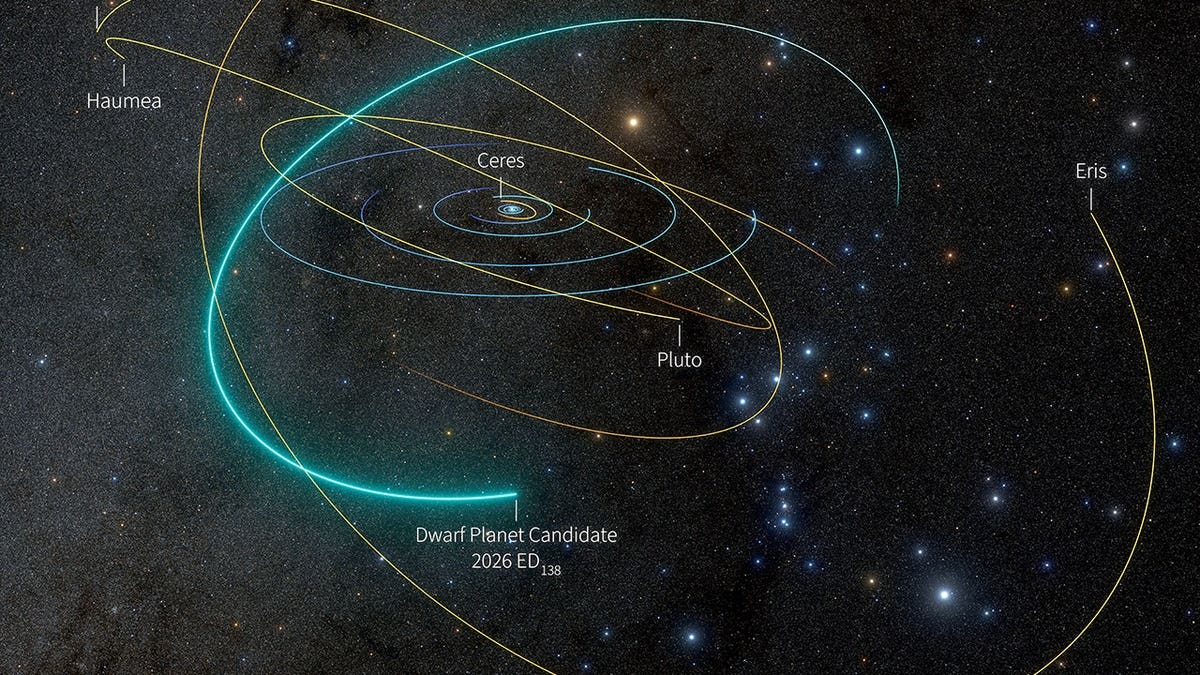
How Was 2026 ED138 Found?
The discovery was made using data from the Simonyi Survey Telescope at the NSF–DOE Vera C. Rubin Observatory in Chile. Interestingly, the object was hidden in plain sight, obscured by the dense star fields of the Milky Way. Matthew Holman, a member of the Rubin Operations team, identified the object while refining the algorithms used to scan for distant, moving bodies.
- Provisional name: 2026 ED138
- Distance: Approximately 46 astronomical units (AU) from the Sun
- Estimated size: 600–1,500 kilometers (370–930 miles) in diameter
- Orbit: Highly tilted, suggesting it was likely disturbed by Neptune’s gravity in the distant past
Why Does This Discovery Matter?
If confirmed, 2026 ED138 would join a prestigious and small club of recognized dwarf planets: Pluto, Ceres, Eris, Haumea, and Makemake. Its potential size—which could place it among the largest objects ever found in that region—provides a rare opportunity for scientists to study the formation and migration history of the outer solar system. The discovery also serves as a proof-of-concept for the Vera C. Rubin Observatory, which has only recently begun its formal Legacy Survey of Space and Time (LSST).
Initial measurements place ED138 among the largest dwarf planet candidates ever discovered beyond Neptune; if confirmed, it would join the five dwarf planets recognized by the International Astronomical Union.
— University of Washington / NSF-DOE Vera C. Rubin Observatory
The Future of Space Exploration
While researchers currently have enough data to confirm its status as a significant TNO, they note that infrared observations are required to determine its exact size and surface composition. This discovery is likely just the beginning. Since the observatory began collecting data earlier in 2026, it has already cataloged thousands of new asteroids and hundreds of TNOs, suggesting that our outer solar system is much more crowded than we previously believed.